E-Class History
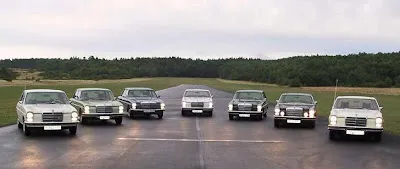
The 200 series, or W114/W115, was a huge success for Mercedes-Benz all over the world and became a benchmark for toughness, elegance and reliability.
- Series
- 200 (W114/W115)
- Unveiled
- 1968 · Frankfurt
- Layout
- 4 doors · three-box saloon
- Legacy
- Forerunner of the E-Class
Historical background
The 200 series, or W114/W115, was a huge success for Mercedes-Benz all over the world.
Germany's most famous maker of luxury saloons, Stuttgart-based Mercedes-Benz, became even better known after 1950. With beautiful, safe and luxurious cars, its prestige was always high in every corner of the world.
In 1968, at the Frankfurt Motor Show, to replace the by then dated 190 (W110 platform), it launched a model that would be very successful: the 200 series, or W114/W115 platform. The new saloon had balanced, modern and handsome lines, with three distinct volumes and four doors, and a huge range of petrol and diesel engines.
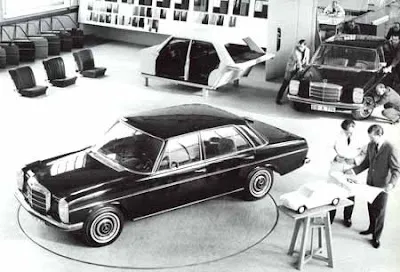
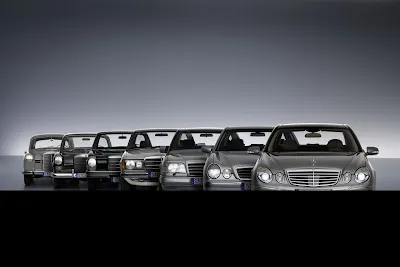
From the easy-going 200 to the more powerful 280, by way of the diesel version, it was one of the most successful Mercedes ever and a true forerunner of today's E-Class.
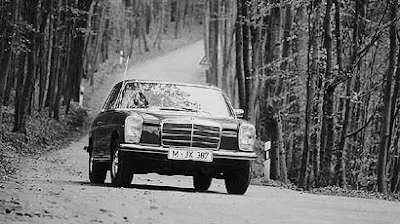
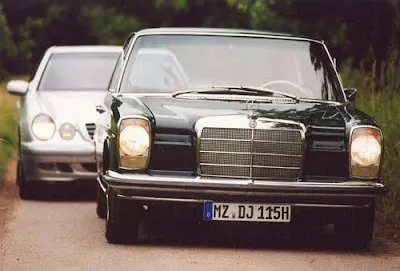
At the front came the traditional radiator grille, topped by the famous three-pointed star, and rectangular headlamps set upright. The rear was handsome and simply drawn. On the boot lid, the star sat in the centre, with the badge identifying the version on the left. It carried five occupants in great comfort. It was called the “small Mercedes”, yet it was 4.68 metres long.
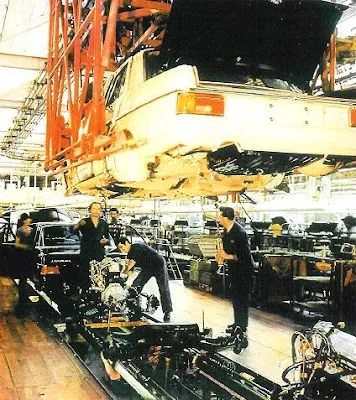
Engines and versions
The basic engine was a 1,988 cc four-cylinder with an overhead camshaft, producing 95 hp at 4,800 rpm. The four-speed gearbox could have a column-mounted lever, for the more traditional, or a floor-mounted one. An automatic was also available. With rear-wheel drive, its top speed was 165 km/h, and acceleration drew no gasps, as it was heavy: 1,310 kg.
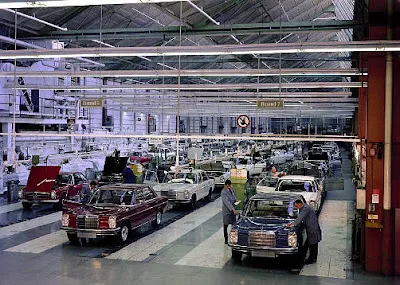
Next came the 220, a little livelier than the 200. The 230 was more appealing, with a 2,292 cc straight-six. Power rose to 120 hp and it had twin carburettors. A five-speed gearbox was optional and top speed was around 175 km/h. Like the other models, it had disc brakes on all four wheels and 14-inch wheels. Every model had handsome hubcaps, with the centre ring in the body colour.
Balanced lines, a comfortable interior and mechanical toughness left no doubt about its origins: this was yet another distinguished series from the Stuttgart marque.
For those who wanted a luxury car that was also economical, there was the 220 D. Its 2,160 cc four-cylinder diesel produced 60 hp, for a top speed of 136 km/h and slow acceleration. Diesel engines at the time were weak, noisy and prone to vibration. But this Mercedes sold in large numbers because it was tough and economical.
In October of the same year, a very successful long-wheelbase version was launched: the Lang (long). It measured 5.34 metres and weighed 1,545 kg. From the side the difference was obvious: a large rear door and three side windows. It was very popular as a taxi and with tour operators, as well as with embassies, consulates and large companies.
In this form it could be fitted with chrome luggage racks on the roof or on the boot lid. Depending on the option, it carried six or seven passengers plus the driver. It could take either the 230 engine or the 220 D.
In 1968, at the Brussels Motor Show in Belgium, a very interesting addition to the range arrived: the 250. Outside, it could be identified by its double-blade bumpers and a grille with thinner bars. The engine was a six-cylinder inherited from the old 250 S, with 2,496 cc, 130 hp at 5,400 rpm and twin carburettors. It had five gears rather than the 230's four. Its top speed was 182 km/h.
Very stable through corners and at high speed, it was quiet and reliable. While no aerodynamic masterpiece, it moved through the air very well, giving the driver a great sense of security.
Inside, the whole 200 range received the same care. Comfortable seats, individual at the front, with or without headrests, good-quality fabric, with leather as an option. The large-diameter steering wheel, in the German tradition, had an outer metal ring to sound the horn. Steering was power-assisted. The dashboard had three round dials, including a rev counter. The sunroof was a very welcome extra that added a touch of charm.
In 1969, also at the Belgian show, a version that is still a collector's item today was unveiled: the coupé. Classic and distinguished, it was not a sports car, but it looked superb. The roof was slightly lower and the windscreen more steeply raked. It was the same length as the saloon, but its doors were longer and the rear pillar more sloped. It was comfortable for four. With the same six-cylinder engine, it was called the 250 C.
In April 1972 another engine became available: a new 2,746 cc unit with twin overhead camshafts and 160 hp at 5,500 rpm. The 280 reached 190 km/h and was also fitted with 185 HR 14 radial tyres. Outside there was a laminated windscreen and an optional headlamp washer. Soon after, this engine was given electronic fuel injection, rising to 185 hp, with a top speed of 205 km/h.
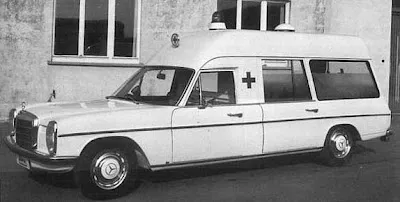
The long-wheelbase version was used in many roles, even as an ambulance.
Evolution and legacy
In October 1973, at the Paris Motor Show, the whole 200 range was given a facelift. The grille was wider and lower, there were new ribbed tail lights at the rear, and inside, the centre of the steering wheel was now padded in rubber. The door mirrors could now be adjusted from inside. The new 240 D had a warning light on the dashboard showing the glow plugs were preheating, so the driver knew when the diesel engine could be started.
In January 1976 the series was replaced by a more modern one. The German factory's magazine, In Aller Welt, showed it against landscapes all over the world, proof of how widely it was accepted. It truly was a reliable, durable car, still seen today in the hands of collectors and ordinary owners who use it every day.